
01 · The first machine
Loray was not simply a building. It was an industrial system.
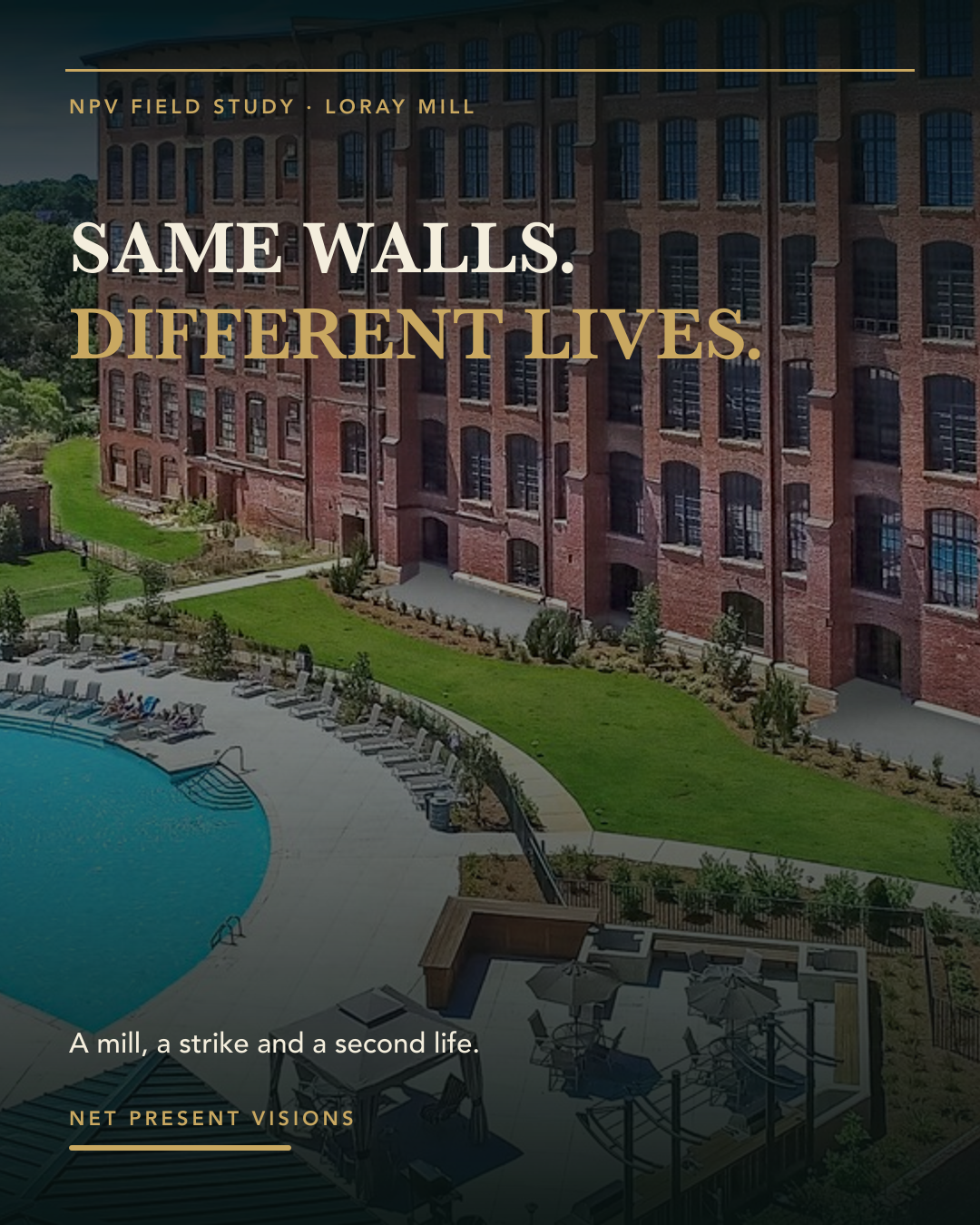
The original Loray Mill was built in 1900–1901 and later expanded in 1921–1922. The National Register record describes nearly half a million square feet in the first building alone, with room for approximately 1,000 workers. Around it sat a mill village spanning roughly thirty blocks.
Inside, people, shafts, belts, machinery, humidity and cotton had to work as one coordinated system. Stuart Cramer's 1908 experimental air-conditioning installation was not a luxury amenity. It was production infrastructure—an effort to control the environment so the cotton and machines would behave more predictably.
02 · The evidence has faces
The value of the archive is that it refuses to let the labor disappear.
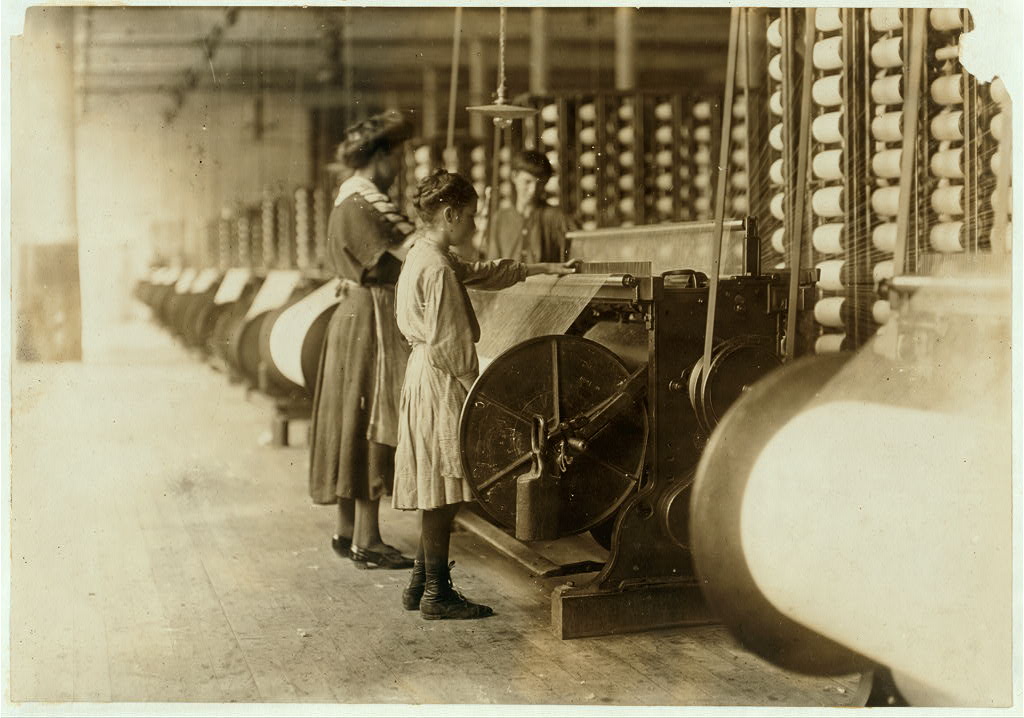
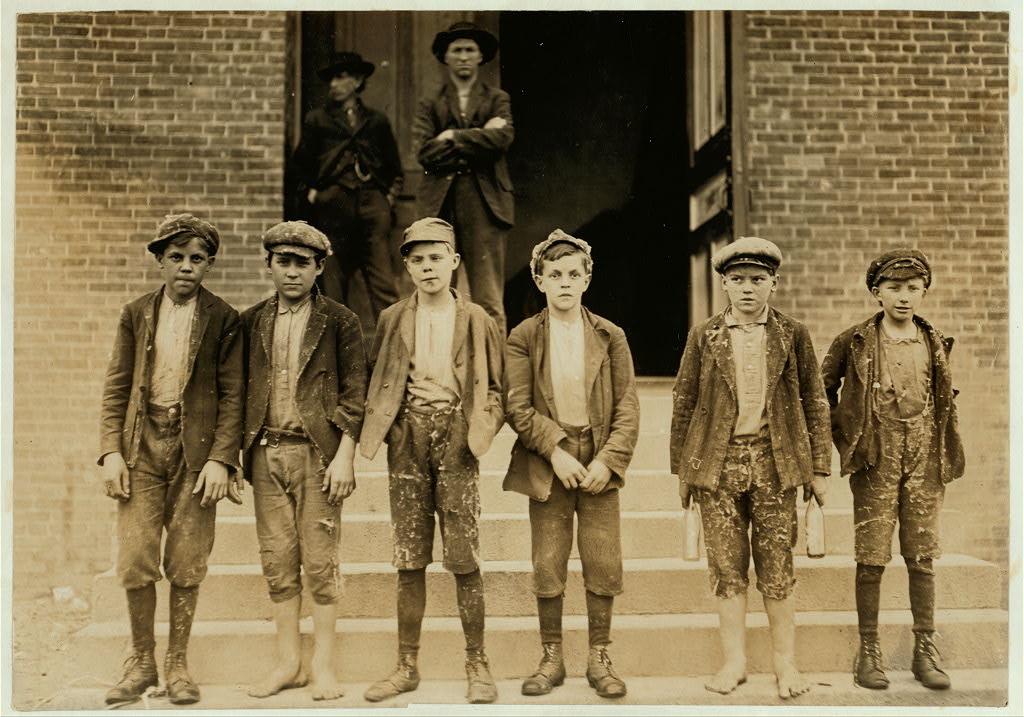
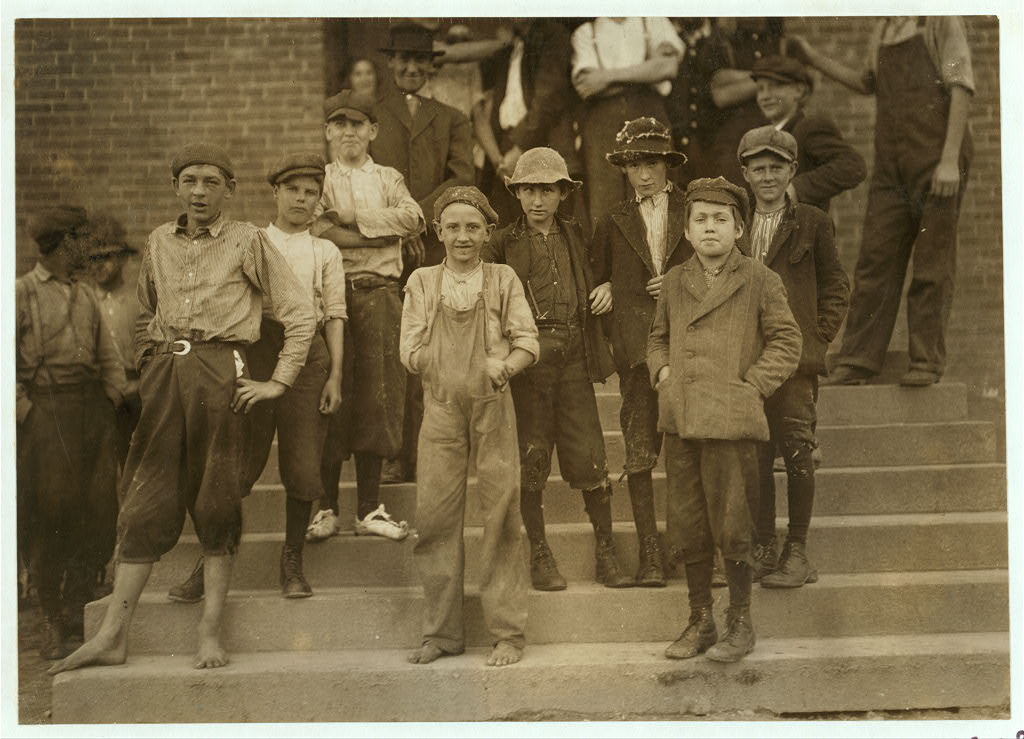
Lewis Hine photographed children associated with Loray in 1908 and again in 1912 as part of the National Child Labor Committee's investigation. The images are not decorative history. They are evidence of who supplied the labor beneath the mill's scale and technology.
That distinction matters for adaptive reuse. A restored brick wall can preserve material without preserving memory. Loray becomes a more honest project when the people who worked there remain visible alongside the polished apartments and commercial interiors.
03 · The business changes
The mill adapted before the real estate ever did.
After Jenckes Spinning Company acquired the operation, production moved from cotton sheeting toward tire fabric for a rapidly growing automobile industry. The 1921–1922 expansion helped make Loray the largest textile mill in the South under one roof, according to contemporary accounts cited in the historic record.
That shift is the first adaptive-reuse lesson. Industrial property is always tied to an operating model. Long before the building became housing, the company had already changed the product, machinery and economic purpose inside the shell.
04 · The breaking point
Efficiency to the owner felt like acceleration to the worker.
Management's labor-efficiency program included what workers called the stretch-out: fewer people were expected to operate more machines. In April 1929, roughly 1,800 of approximately 2,200 employees walked out. The dispute involved work intensity, wages, union activity, political fear, policing and conditions in the mill village—not a single grievance that can be reduced to one dramatic night.
The National Guard was deployed. Police Chief Orville Aderholt was killed during a confrontation at union headquarters. Ella May Wiggins—a worker, organizer and ballad singer—was later killed during the broader conflict. Murder trials and the strike drew international attention, but the walkout failed to produce the transformation workers sought.
05 · Firestone and silence
One of America's largest industrial names gave the building another long life.
Firestone acquired Loray in 1935 and operated the property until 1993. That nearly six-decade chapter connected the mill to a national manufacturer and kept its industrial purpose alive long after the strike faded from daily attention.
When manufacturing ended, Loray did not instantly become a celebrated redevelopment opportunity. The building passed through years of vacancy while its scale became both the source of its potential and the reason the rescue was so difficult.
06 · The capital stack
The romance only becomes real when the financing closes.
Joe Lenihan, John Gumpert and Billy Hughes acquired the property for $660,000 in 2013 after years of financing work. Phase I opened in 2015 with about 190 loft apartments and roughly 85,000 square feet of commercial space.
The current second phase shows why historic rehabilitation is more than design taste. NTCIC describes a $52 million investment converting 164,000 square feet into 143 apartments, supported by $8.3 million in federal historic tax credits and $16.5 million in North Carolina Mill Rehabilitation Tax Credits. The building's past became part of the capital stack that could finance its future.
- Historic tax credits can convert preservation requirements into an investable financing source.
- Large old buildings often require phasing because the entire risk cannot be solved at once.
- A low acquisition price does not mean a cheap project; rehabilitation cost and execution risk dominate the equation.
- The finished property must generate enough demand to support the capital assembled around it.
07 · What was preserved
The shell survived. The harder test is whether the meaning did.
The mill's mass, brick, repetitive windows and industrial rhythm remain legible. The first phase turned a structure that had gone quiet into homes and commercial space. The second phase promises to place another 143 households inside a building once organized around textile production.
But preservation is not automatically interpretation. If residents and visitors see only attractive brick, Loray's workers become invisible again. The strongest version of this redevelopment is one where the architecture, public history and economics reinforce each other—where the building is useful precisely because its difficult story remains part of the experience.
08 · What we still need to know
This field study remains open.
The verified public record explains the broad transaction and the major historical chapters. It does not yet answer the operational questions that determine whether the new use truly works. NPV wants to speak with the development team, current operator, preservation partners, tenants and Gastonia residents before treating this story as complete.
- What feature of the mill created the most value in the completed first phase?
- Which historic requirement produced the largest cost or design constraint?
- How have the commercial spaces performed relative to the residential program?
- What changed in the capital markets between Phase I and the $52 million Phase II?
- How is the 1929 labor history interpreted for residents and visitors today?
- What would the team preserve differently if it could begin again?
Source record
Read the primary material.
- Library of Congress — Historic American Engineering Record: Loray Mill ↗
- National Park Service — Loray Mill Historic District nomination ↗
- Library of Congress — Lewis Hine photograph: girls at warping machines ↗
- Library of Congress — Lewis Hine photograph: Loray closing hour ↗
- Library of Congress — Lewis Hine photograph: young worker at closing ↗
- Library of Congress — Lewis Hine photograph: boy who worked at Loray ↗
- Library of Congress — Lewis Hine photograph: noon-hour children ↗
- North Carolina DNCR — Loray Mill Walkout of 1929 ↗
- NC ANCHOR — Primary sources from the Loray Mill strike ↗
- NTCIC — Loray Mill redevelopment profile ↗
- Preservation North Carolina — Phase II redevelopment ↗
- TriBridge Residential — Construction pipeline ↗
- WFAE — Loray Mill's new life and neighborhood hopes ↗
Independent educational analysis by Net Present Visions. Company-reported figures are identified as such. This is not investment advice.